
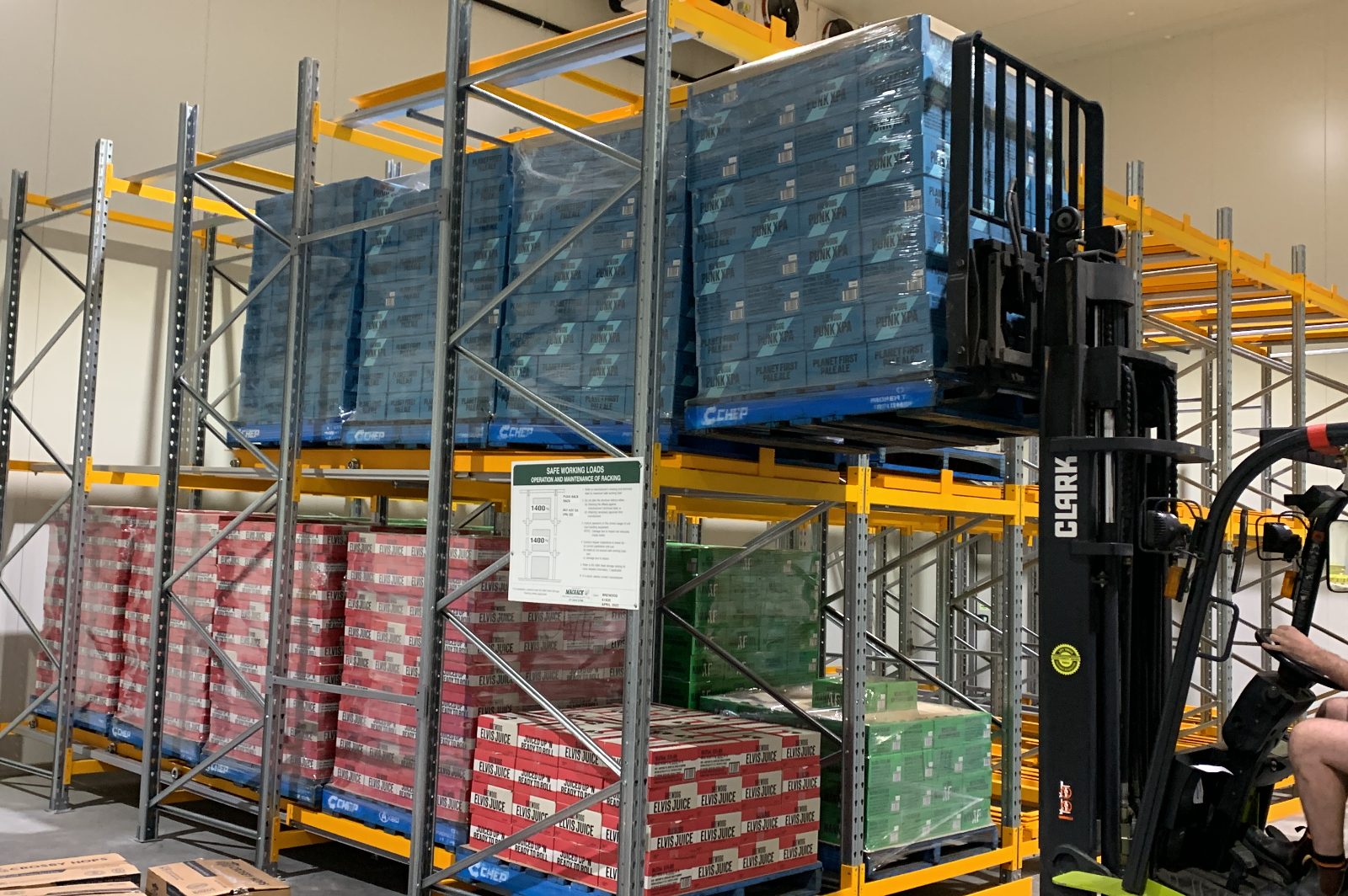
The most common pallet size you will see in Australian warehouses is the standard Australian pallet, which is generally 1165mm x 1165mm x about 150mm high.
That is the pallet most people are talking about when they refer to a standard pallet in Australia. This size is set by the big players in the industry, including Wesfarmers, CHEP and Loscam. In a lot of major industries, especially where goods are being moved through supermarkets, distribution centres and larger supply chains, the Chep and Locsam pallets are not actually bought outright. They are rented out, exchanged between companies, and tracked through the business as goods move backwards and forwards.
Those CHEP and Loscam pallets are usually hardwood pallets. They are robust, strong, and designed to be moved through a proper warehouse system over and over again.
You can also organise your own Australian standard pallets made from pine, and in some cases hardwood as well. The pine ones are generally less robust, but they are pallets you would normally own and use as you see fit.
The important thing from a racking point of view is that standard Australian pallets are what standard Australian pallet racking is generally designed around.
Common Pallet Sizes Used In Australia
As a general guide, these are the pallet sizes you are most likely to come across in Australian warehouses.
| Pallet type | Common size | Where you usually see it |
| Standard Australian hardwood pallet | 1165mm x 1165mm | Warehousing, manufacturing, supermarkets, distribution, CHEP and Loscam systems |
| Standard Australian pine pallet | 1165mm x 1165mm | Owned pallets, local stock movement, general warehouse use |
| Euro pallet | 1200mm x 800mm | Imported goods |
| European-style pallet | Around 1200mm x 1000mm or similar | Imported goods |
| Asian/export pallet | Often varies, commonly around 1100mm x 1100mm or other non-standard sizes | Imported goods |
| Plastic pallet | Varies | Food, pharmaceutical, hygiene-sensitive and internal warehouse use |
The main issue is that not all of these pallets work the same way in pallet racking.
Standard Australian Pallets And 840mm Deep Pallet Racking
Australian standard pallets predominantly use standard selective pallet racking, which is usually 840mm deep.
That can look wrong to someone who has not dealt with much racking before, because the pallet does not sit fully within the depth of the rack. The pallet overhangs the racking by roughly 150mm at the front and back.
A lot of people look at that and get concerned because the pallet is hanging over the edge. But with Australian pallets, that is actually how the system is meant to work.
The standard Australian pallet has a slat of timber at the front and a slat at the back on the underside. Those timber slats lock the pallet into the pallet racking. So even though the pallet is overhanging the rack, it is sitting the way it is supposed to sit.
Euro Pallets And Imported Pallets Are Different
Euro pallets are a different story. They are generally smaller or narrower than Australian pallets, this smaller dimension means that they do not sit on 840mm deep pallet racking the same way an Australian pallet does
If you are importing goods from Europe, the best solution is usually to look at 1200mm deep pallet racking with a mesh deck or another support system so the pallet can sit properly.
Mesh decks are a very common practice in Europe, and it becomes common in Australia when someone is importing a lot of stock from Europe.
The same applies to a lot of Asian pallets. You see a wide variety of pallet sizes come in from overseas. A lot of them are much lower quality and are really only there to get the goods in and out of a shipping container. They are not necessarily designed for long-term warehouse storage in a proper racking system. When it comes to using them on pallet racking they are usually better suited to selective racking with mesh decks, or the goods need to be transferred onto Australian standard pallets.
CHEP, Loscam And Pallet Rental Systems
CHEP and Loscam pallets are very common because a lot of the major players effectively demand that system. If you are supplying into large retailers, food distribution, grocery, manufacturing or national distribution networks, there is a good chance you will come across CHEP or Loscam pallets.
Those pallets move between businesses, and there is a running tab within the business keeping stock of these pallets where you pay rent on the pallets you have in your possession. Once the goods move on, the pallets are exchanged, returned or transferred through the system.
Warehouses Often Use More Than One Pallet Size
There are a good number of warehouses that do not run on one neat pallet size. Manufacturing warehouses, food producers, importers and businesses using a mix of local and overseas suppliers often end up with a variety of pallets.
A tell-tale sign of these locations is stacks of random pallets sitting out the front, in the car park, or around the edges of the warehouse. That usually tells you the business has goods coming in from different suppliers of different origins, on different pallet types, and they are trying to work out what to do with them post unloading.
For example, a food manufacturer may receive some goods on random supplier pallets or market pallets, but send finished product out on CHEP or Loscam pallets because that is what the supermarkets require. An importer may bring goods in from Europe on Euro pallets, receive local packaging or boxes on Australian pallets, and then send finished goods out on a completely different system again determined by their customers requirements.
What Happens When Racking Is Designed Around The Wrong Pallet Size?
When pallet racking is designed around the wrong pallet size, the problem is usually very clear. The racking goes in, the installers walk away, and then the phone call to the racking supplier comes:
“It doesn’t work.”
It simply does not work.
That is why you need someone with technical knowledge and experience to tell you what you actually need before the racking is installed.
If your racking is designed for standard Australian pallets, but most of your goods are arriving on Euro pallets or odd imported pallets, the pallets will not sit safely or cleanly in the rack. They may not bridge the beams properly, they may need support underneath, or they may need to be taken off the original pallet and put onto an Australian standard pallet before they can be stored.
There are workarounds, but they need to be planned, you can use mesh decks on pallet racking, and that essentially turns the rack into one big heavy-duty shelving system. Once mesh decks are installed, you can store a wider variety of pallet types and even awkward items, because the deck gives support underneath.
In a lot of cases, the simpler long-term solution is to take the goods off the imported pallet and put them onto an Australian standard pallet.
Transferring Goods Onto Australian Pallets
One common solution is to manually change goods over from an international pallet to an Australian standard pallet.
For example, if goods come in on Euro pallets, the business may unload those goods and transfer them to Australian pallets before putting them into the racking. The same thing can happen with Asian import pallets or other one-way pallets.
In some industries, the stock may be moved onto plastic pallets instead. You see that in areas like food and pharmaceutical warehousing, where hygiene and internal handling requirements are a big part of the operation.
So the question is not just, “What pallet size do you use?” The better question is: What pallets do the goods arrive on, what pallets do they leave on, and what pallets do they need to sit on while they are inside your facility?
Planning For Both Australian And International Pallets
Some businesses know from the start that they are going to handle both Australian and international pallets. In that case, the racking system should be planned around the operation, not just around the first pallet someone measures. To give an example, a business importing packaging on Euro pallets while also receiving local goods on Australian pallets. In that situation, you need to look at how both pallet types can be stored efficiently within the same warehouse.
Sometimes the best solution may be deeper racking with mesh decks, it may be a separate storage area for imported pallets, it may be transferring everything onto Australian standard pallets, and in some cases, a different racking system entirely can solve the problem.
For example, drive-in racking might be arranged so that European pallets are loaded one way and Australian standard pallets are loaded another way, where the key dimensions cross over closely enough for the system to work.
Pallet Size Also Affects The Type Of Racking System
Different racking systems behave differently with pallet sizes.
For standard selective pallet racking, Australian standard pallets work very well because the system is designed around them.
For systems like:
- Drive-in racking
- Push back racking
- Shuttle racking
- Pallet flow systems
You generally want Australian standard pallets, and ideally good hardwood pallets. Pine can work in some situations, but for those systems you want the pallet to be strong, consistent and suitable for the way the rack operates. The more specialised the system becomes, the more important the pallet quality becomes.
A rough one-way pallet from an overseas container may be fine to get goods from one country to another, but is often not suitable for a high-density racking system.
Advice For Businesses Setting Up Racking For The First Time
The biggest advice is: know your market.
If you are starting a small to medium business, you may not be across the whole situation immediately. You may not know yet what every supplier will send you, what pallet sizes will arrive, how high the goods will be stacked, or what your customers will expect goods to go out on.
So do not overcommit too early if you are not sure.
If someone sells you a full warehouse of racking and it turns out to be wrong for the pallets and goods that start coming through the door, you have created a problem before the business has even settled into its normal rhythm. It is better to build the warehouse organically as you grow, especially if the business is still working out its suppliers, customers and stock movement. Racking is there to support the way your business runs. It should not force the business into a system that does not suit the goods.
At the same time, good racking can be flexible. It can be moved, adjusted, extended and changed as the business grows. But the more information you can give at the start, the better the initial design will be.
Need Racking Designed Around Your Actual Pallets?
Pallet size is one of those things that looks simple until the racking goes in and the pallets do not work.
Standard Australian pallets, Euro pallets, Asian import pallets, plastic pallets, pine pallets and CHEP or Loscam pallets can all change the way a warehouse needs to be set up.
The best result comes from looking at the business as a whole. What comes in, what goes out, what gets stored, what gets broken down, what forklift is being used, and what pallet types the business is actually handling day to day.
That is where proper racking design makes the difference.
Macrack can help design pallet racking around your actual pallet sizes, product weights, warehouse layout and forklift requirements, so the system works properly from the start.
About Leo Kanas
Leo Kanas brings over two decades of hands-on experience in warehouse storage systems and racking design. As Project Manager and lead designer at Macrack Australia, Leo works at the intersection of engineering, layout optimisation, and customer-driven solutions. He holds qualifications in project management and industrial design, and has overseen dozens of warehouse redesigns across Australia. Leo is passionate about helping businesses unlock hidden capacity, streamline workflows, and future-proof their storage systems.
Contact The Team at Macrack Today
We’re The Experts in Industrial Racking and Storage Solutions